

8/29/2025
In 2023, when I was writing my memoir, Dr. Beare’s Daughter, I wanted to write about when I was maybe four years old in the early ‘50s and visited the Ojibway village on Batchewana Bay on the shore of Lake Superior in Ontario.
We lived in Celina, Ohio, the county seat of Mercer County. My father loved to drive on long road trips. He loved the wild places, and he loved to fish. That summer, my father, mother, grandpa, and I stayed at a remote fishing camp north of Sault St. Marie on Lake Superior. I remembered that the name of my father’s fishing guide was Joe Tom, and he was the chief of the Ojibway. I remembered going with my dad to Joe Tom’s village and taking boxes of blankets, clothing, and other useful things to his people. I had a vague memory of my father threading our Cadilliac through the woods as there was no road to the village. Was my memory correct? Was my father’s fishing guide really the chief of the Ojibway people? Did I imagine that drive through the trees?
To check my memory, I searched online and found a list of the hereditary chiefs of the Ojibway. I found Joe Tom Sayers listed as chief of Batchewana First Nation in 1949. Sayers! Yes, I remember—that was his last name. I also came across another Joe Tom Sayers currently listed as General Manager of the Missanabie Cree Business Corporation in Sault St. Marie. I called him. He’s Joe Tom’s grandson!
I told him that I had known his grandfather and I that I had visited the village on Batchewana Bay in the early 1950s. He said that my memory of the drive through the woods was correct—at the time, there was only a cart track through the forest. When I told him that we took goods to his grandfather’s house, he asked me, “Do you have any hooked rugs?”
I was going to say no, but he continued, telling me that his grandmother, Mary Jane, had made hooked rugs with designs that showed the natural world around her. Each one was a unique piece of art. He went on to tell me that the Ojibway saw themselves as independent. They made the most of what they needed and bartered for the rest. His grandmother had used her rugs for barter. I realized that his grandfather likely wouldn’t have accepted gifts from my father without giving something back—one of Mary Jane’s rugs.
And then I remembered . . . the small rug that had laid for many years, next to my bed. I knelt on it every night to say my prayers throughout my girlhood. It depicted a native paddling a canoe on the water. It was different than any other rug I had ever seen. I told Joe Tom that, yes, my family once had one of his grandmother’s rugs. Neither my parents nor I kept the rug when our house in Celina, Ohio was sold in 1980. The rug had to have been included in the estate sale.
On a whim, I did a Google search using the terms, “hooked rug,” “native in a canoe,” “photo.” Many photos of native American hooked rugs popped up and among them was my rug! I refused to believe it. And yet . . . I not only recognized the rug, but I also recognized the brown stain near the middle of the canoe. I don’t know how that stain got there, but I vividly remember kneeling on that spot every night to say my prayers before bed.
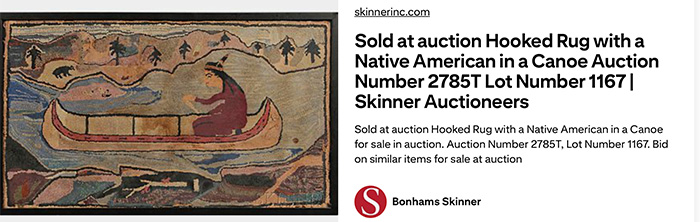 The photo of the rug was from a listing of an auction that had taken place at the Bonhams Skinner Auction House in 2015 in Boston. The rug was famed under glass and sold as a late nineteenth century native American artifact. It had to be my rug . . . but . . . how did it end up in Boston?
It still seemed too fantastic to be true, so I set out to prove it. I called the auction house in Boston and asked them who had commissioned the sale of the rug. They would not give out contact information, but the rug was commissioned for sale by an antiques dealer in Youngstown, Ohio.
Ohio! I was getting warm.
I searched for antiques dealers in Youngstown and found an old website for one that mentioned the owners had formerly operated an antiques store in Dayton, Ohio.
Dayton is eighty miles from Celina! I was getting hot.
I wrote a letter asking about the rug and included my contact information.
A week later I got an email from the woman who had received my letter. She said that according to her records, her husband bought the rug from an estate sale in Mercer County, Ohio in 1980. They kept it until they sold it at auction in Boston in 2015 when they retired from their business.
Bingo! I’d solved the mystery of how Mary Jane’s rug, had traveled to Boston. Now it seemed important to get the history of the rug to its current owner. I wanted the rug to travel forward in time with Mary Jane Sayers’ name attached.
Once again, the auction house said they do not release personal information from their files. However, the head of Bonhams Skinner’s Rugs and Carpet Department, found my story interesting and agreed to research and contact the buyer to share the origin of the rug. He reported back to me that while the rug was not for sale, they were interested in receiving the rug’s provenance.
Once again, I called Joe Tom. To my story of the rug, he is adding a photo of Mary Jane, and some stories about her life. He also has research to show how a museum in Quebec discovered a link between the Ojibway of Batchewana Bay and the Ojibway of Quebec, via the hooked rugs his grandmother made, and the rugs made by the Quebec women.
Now it’s time for me to put this side trip into history—aside and get back to finishing my novel, The Night the Bridge Cried, to be published in late Fall. That is, if I don’t get distracted with another side trip.
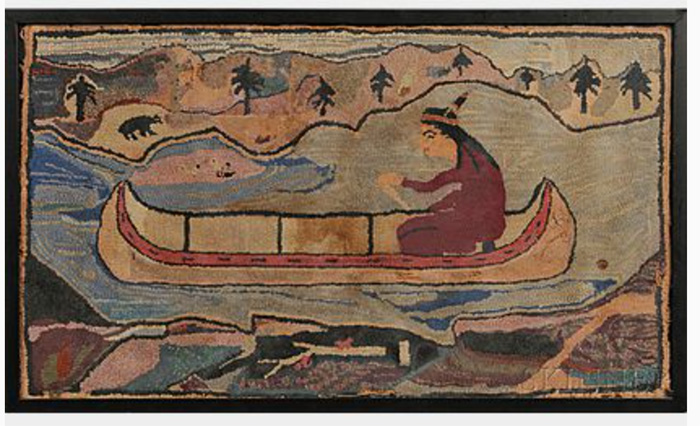 My prayer rug, with that odd, brown stain I knelt on every night.